
Sustainability and Climate Strategy
Sustainability and Climate Strategy
Our sustainability and climate strategy has been developed in response to major shifts in the external environment – from increasing climate risk and nature loss to technological developments, new regulations and stronger expectations for responsible business conduct. These developments make it necessary to set a clear direction for how SpareBank 1 Sør‑Norge will contribute to the transition, social inclusion and a more resilient society.
The strategy is intended to guide the entire Group and support employees and leaders in their daily decision-making. It also demonstrates to customers, investors and other stakeholders how sustainability is integrated into our business and how it influences the way we make decisions. The strategy should be viewed in conjunction with other internal governance documents, such as the Group strategy and the associated business plan, and applies to the entire Group, including subsidiaries.
SpareBank 1 Sør‑Norge revised its sustainability strategy in the autumn of 2025. The new strategy applies to the period 2026–2030. It is closely integrated into the Group’s overarching strategy and supports the Group’s purpose: to drive growth and development. The strategy is built on the UN Sustainable Development Goals, the UN Global Compact and the UN Principles for Responsible Banking.
Through the seven savings bank foundations – Sparebankstiftelsen SR-Bank, Kvinheradstiftinga, Sparebankstiftelsen Modum, Sparebankstiftelsen Nøtterøy–Tønsberg, Sparebankstiftelsen Buskerud Vestfold, Sparebankstiftelsen Nome and Sparebankstiftelsen Telemark – the Group makes a significant contribution to society by distributing grants to charitable causes. This is an important part of our role in strengthening local value creation and supporting sustainable development in the regions where we operate.
In a world marked by increasing uncertainty, it is more important than ever that SpareBank 1 Sør‑Norge stands firm in its sustainability ambition: to contribute to the transition by being the customer’s ally in the sustainability shift.
This means that sustainability must be integrated into the Group’s core business – in everything we do. It must influence how we create valuable customer experiences, how we deliver results, how we run our operations, how we collaborate internally and externally, and how we contribute to society. All employees are expected to take an active and responsible approach to sustainability. In practice, this means that sustainability considerations must be integrated when we:
- make decisions on new or amended products and processes
- develop credit tools for the corporate and retail markets
- take major investment decisions
- develop employees’ core competencies
This is not a new strategic initiative for the Group, but a continuation of a direction that has been firmly established for several years. This direction is also embedded in the Group strategy.
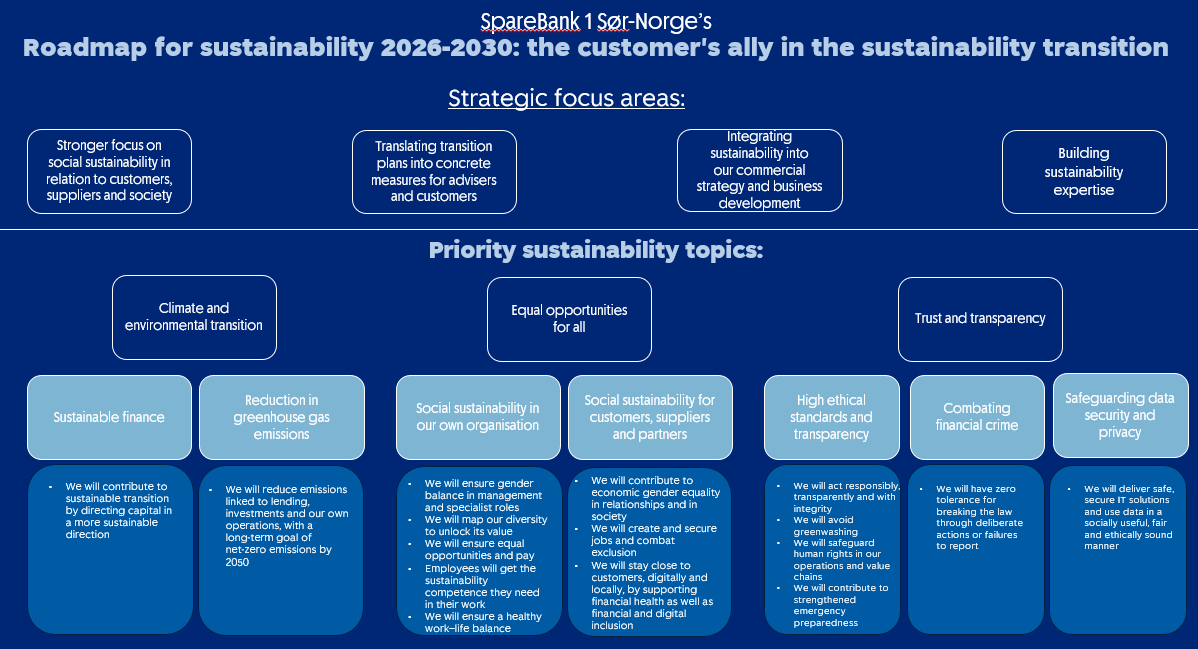
The strategy has three main topics:
Climate and Environmental Transition, Equal Opportunities for All, and Trust and Transparency.
Read more HERE
In the short term, the Group will focus on the following priorities:
- Integrating sustainability into commercial strategy and business development
- Translating transition plans into concrete actions for advisers and customers
- Strengthening sustainability competence among employees
- Enhancing the focus on social sustainability towards customers, suppliers and society
Products such as transition loans, energy‑efficient home loans, sustainability‑linked loans, energy‑upgrade loans and savings products with a sustainability profile, as well as advisory services related to climate accounting and sustainability strategy, are central instruments.
The Group’s most significant sustainability impact occurs through its customer work – by financing and advising on sustainable choices. The climate transition plan, with a target of net zero emissions by 2050, is a key part of the strategy and is followed up with concrete measures and interim targets. Requirements are set for both customers and the Group’s own operations, including procurement and value chains.
Reduction in greenhouse gas emissions.
We will reduce emissions linked to lending, investments and our own operations, with a long‑term goal of net‑zero emissions by 2050
We will contribute to the reduction of greenhouse gas emissions by working to lower emissions from our customer portfolio and by reducing the climate footprint of our own operations, products and services. Our long‑term ambition is to achieve net zero emissions from lending, investments and operations by 2050. Progress is measured annually. These targets are detailed in the Group’s climate transition plan, which includes 2030 interim targets for the sectors where we have developed emissions‑reduction pathways based on estimated financed emissions (shipping, oil & gas, agriculture, commercial real estate and residential real estate), as well as for our own operations. Emissions from our own operations are very limited compared with financed emissions. Still, we will do our part and have established a transition target for our operational footprint.
Developments in the external environment show a growing emphasis on sustainability, particularly climate challenges. Through its business activities, SpareBank 1 Sør‑Norge aims to contribute to emission reductions at both national and global level. Our ambition is to strengthen the Group’s and our customers’ ability to adapt to, and reduce the consequences of, climate change.
We will continue to support and set requirements for our corporate customers and suppliers to ensure that they actively assess how they can reduce their greenhouse gas emissions. The Group supports the Paris Agreement and has implemented measures to align with a Paris‑adjusted strategy. These measures will reduce our exposure to climate‑related risks and enable us to capture opportunities arising from the energy transition. The Group will implement concrete actions to reduce greenhouse gas emissions in line with the Paris Agreement’s goal of limiting global warming to 1.5°C by 2050.
Sustainable finance.
We will contribute to sustainable transition by directing capital in a more sustainable direction
We will contribute to the sustainable transition by channelling capital in a more sustainable direction. The financial sector’s most important lever in the transition is responsible investment, ensuring that capital is allocated to activities that are viable in an economy operating within planetary boundaries. The industry can act as a driving force, but depends on external factors such as policy, regulation, markets and technological development to set direction and pace. SpareBank 1 Sør‑Norge will do its part, and has set a target that at least 25% of the total loan portfolio shall qualify as sustainable by 2030.
The Group has developed a framework for sustainable finance that defines which loans qualify—covering the reduction of greenhouse gas emissions, climate adaptation, pollution prevention and control, circular solutions, biodiversity, and the sustainable management of living resources, natural resources and land use. The framework supports investments ranging from green buildings and renovation of existing properties to solution providers in renewable energy and cleantech. It will be updated in line with regulatory and market developments.
The group has set the following goals for SDG 13:
- Net zero emissions from our own operations and from the lending and investment portfolio by 2050.
- At least 25% of the total loan portfolio shall qualify under the group’s sustainable financing framework by 2030.
Social sustainability in our own organisation.
To strengthen efforts on equality and diversity internally, we have established a dedicated group to work on these issues going forward. We have set ambitious goals that are challenging to achieve in the short term but are the right direction for the long term:
- Strive for gender balance in leadership and senior specialist roles.
- Map our diversity to leverage its value.
- Ensure employees build the sustainability competence they need for their roles.
- Maintain a balance between work and leisure.
- Promote equal opportunities and equal pay.
Equal opportunities include ensuring diversity and inclusive processes in recruitment, competence development and remuneration. Our working environment and culture shall be characterised by zero tolerance for discrimination, harassment and bullying. We will value different perspectives and make use of the strength that lies in diversity, and we will facilitate accessibility and inclusion for employees with different functional needs. Our leaders will develop the ability to lead diverse teams effectively.
Social sustainability for customers, suppliers and partners.
As a financial group, SpareBank 1 Sør‑Norge has significant potential to influence customers, suppliers and partners within social sustainability.
There is a documented income and wealth gap between men and women in Norway, and as a bank we have both the opportunity and the responsibility to help reduce this gap. This can be achieved through awareness‑raising, financial advice, and thoughtful development of products and services.
Financial and digital exclusion is an increasing challenge, driven by rapid digitalisation combined with demographic changes (more elderly people, more refugees and more individuals outside the labour market). It is especially important that large institutions like banks do not contribute to widening these exclusion gaps. Through our many well‑designed physical branches and cooperation with local municipalities, we help ensure access to financial services for groups who often face barriers. Online and mobile banking are major advancements—but only for those who are able to use them. We therefore take responsibility for ensuring that as many people as possible can participate in the digital society.
For companies, addressing social sustainability offers significant advantages—for employees, customers, owners and other stakeholders. We aim to take a clear position on this and highlight these advantages for our corporate customers. Initially, this involves raising awareness about meeting legal requirements such as the Transparency Act, the activity and reporting duty, and the gender balance requirements for corporate boards. Beyond these obligations, companies can do much more to strengthen their social sustainability performance—and this is where SpareBank 1 Sør‑Norge can play a meaningful role.
For external social sustainability, we have set the following objectives:
- Contribute to financial equality in relationships, businesses, and society at large.
- Create and secure jobs and combat social exclusion.
- Be close to customers—digitally and locally—by promoting financial health and financial and digital inclusion.
The group has set the following goals for SDG 5:
- We will promote equal opportunities and equal pay
- We will work towards gender balance in management and specialist positions
- We will contribute to economic equality in relationships, businesses and in society
The group has set the following goals for SDG 8:
- We will ensure a healthy balance between work and private life
- We will create and safeguard jobs, and combat social exclusion
High ethical standards and transparency
Our advice and solutions shall be characterised by openness and transparency, with conduct that is honest and worthy of trust. SpareBank 1 Sør‑Norge will work actively and systematically to maintain confidence in the financial markets.
- Our employees must always uphold high ethical standards and are required to review and sign the Code of Ethics annually
- We will be open and honest about our sustainability initiatives and avoid any form of greenwashing
- We will safeguard human rights by promoting transparency in supply chains—both within our own operations and among our customers
- We will help strengthen preparedness among our customers and in the local communities where we operate
We make responsible investments that consider risks, impacts and opportunities related to climate, the environment, social conditions and corporate governance. This applies to companies in which the Group holds ownership interests, as well as to the expectations and requirements we place on the managers of the mutual funds we offer to our customers.
The Group’s contribution to preparedness and payment security is particularly relevant in a time of significant geopolitical uncertainty. Increasing threats—such as cyberattacks, natural disasters and geopolitical events—can affect both customers and the bank’s own operations. In light of Norway’s national preparedness plan, which highlights the security risks related to climate change, and the Norwegian Armed Forces’ emphasis on local self‑sufficiency in energy and food, our work on sustainable finance and reducing greenhouse gas emissions also has an important preparedness dimension. The same applies to our efforts to promote financial inclusion.
By prioritising security and preparedness, the bank can protect its assets, maintain the trust of customers and investors, and—most importantly—ensure continuity of critical services during times of crisis.
Combating financial crime
Economic crime, including labour market crime and money laundering, is a serious societal challenge that we work actively to combat.
- We will maintain zero tolerance for violations of the law, whether through deliberate actions or failure to report as required
The importance of complying with sanctions regulations has increased in light of geopolitical instability in our region. Breaches of these regulations can result in fines, reputational damage and loss of access to international payment systems
Safeguarding data security and privacy
In an increasingly connected and digitalised world, data security is becoming ever more important. We receive and store large volumes of (customer) data, which we have a responsibility to handle with the highest level of professionalism—both through our IT solutions and through the competence of our employees.
- We will deliver safe and secure IT solutions and use data in a socially beneficial, fair and ethically responsible manner.
The group has set the following goals for SDG 5:
- SpareBank 1 Sør‑Norge maintains zero tolerance for violating the law, whether through deliberate actions or failure to report as required.
- SpareBank 1 Sør‑Norge will deliver safe and secure IT solutions and use data in a socially beneficial, fair and ethically responsible manner.
- SpareBank 1 Sør‑Norge shall be characterised by high ethical standards, with reliable and lawful processing of personal data that safeguards confidentiality, integrity and availability.
- We will safeguard human rights in our operations and value chains.
- We will contribute to strengthened preparedness